Venice water bus · field guide
vaporettomeaning
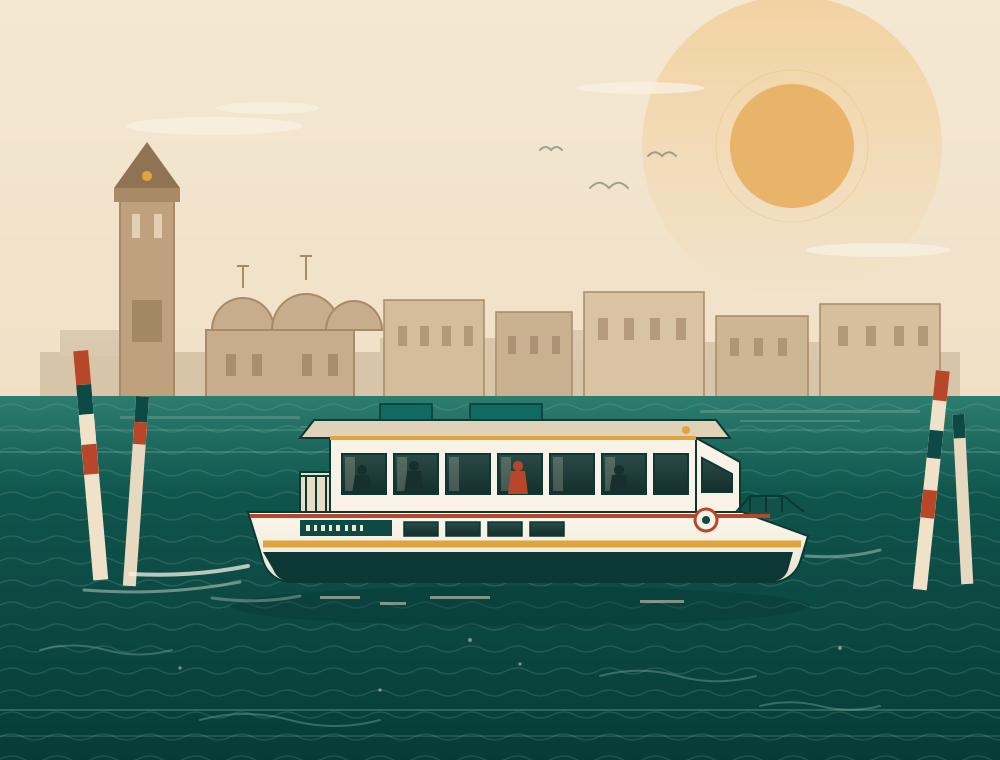
A vaporetto is Venice's public water bus: a scheduled passenger boat that links the historic center with the lagoon islands. The word is Italian for little steamer — and the boats have kept the name long after the steam went out of them.
- Pronunciation
- /ˌvæpəˈrɛtoʊ/vah-poh-RET-toh
- Literally
- “little steamer”vapore + -etto
- Plural
- vaporettiveh-poh-RET-tee
- Single fare
- €9.5075 minutes, 2026
01 — Definition
What does vaporetto mean?
The short answer, the grammar, and the one thing most visitors get wrong.
A vaporetto is a public water bus in Venice: a scheduled passenger boat that you board at a floating stop and pay for with a ticket or a travel pass.
It is a countable noun. One boat is a vaporetto; two or more are vaporetti. In English the word is used almost exclusively for Venice — you would not call a ferry in Naples or a lake steamer in Como a vaporetto. It names the boat, not the company, the route or the ticket, which is why “take the vaporetto” works whether you mean Line 1 up the Grand Canal or the No. 12 out to Burano.
The literal sense is “little steamer”, from Italian vapore (steam) plus the diminutive suffix -etto. Venice's first public steam launches began running in 1881, and the nickname stuck even after the fleet switched to diesel. Today's boats are motor vessels, but the word on the timetable is still vaporetto.
In everyday Venetian speech it is simply the bus. Residents commute on it, students take it to school, and the same boat that carries commuters at 07:30 carries sightseers past the Palazzo Ducale at noon. That dual life explains most of the practical advice on this site: the vaporetto is transport first, attraction second.
02 — Pronunciation
Say it with the stress on RET
Four syllables, one strong beat. The double t is not silent.
English · IPA
/ˌvæpəˈrɛtoʊ/
vah · poh · RET · toh
Italian speakers say [vapoˈretto] with pure vowels and a held double t. English speakers usually relax the first vowel to “uh”, which is fine — what matters is putting the beat on the third syllable, not the second.
Full pronunciation guide, including the three mistakes to avoid →
03 — Etymology
Why a diesel boat is called a “little steamer”
A word built in the 19th century that outlived the technology it described.
Vaporetto is a diminutive of vapore, the Italian word for steam or vapour, which comes from Latin vapor. Add -etto — the suffix that turns casa into casetta (little house) and piazza into piazzetta (little square) — and you get “little steamer”.
The name dates from the age of steam. Venice's first public steam launches began operating in 1881, and they were small, noisy and unmistakably powered by vapour. When the fleet moved to diesel in the 20th century, the word did not move with it. Venice kept calling the public boats vaporetti the way English keeps “tram” for vehicles that no longer run on tracks and “Hoover” for any vacuum cleaner.
That is also why the word feels slightly wrong the first time you see a modern boat: there is no steam, no funnel and no coal. The etymology is a fossil, and the timetable is the only place it still shows.
The full etymology, from Latin vapor to the 1881 steam launches →
04 — Distinctions
What a vaporetto is — and what it isn't
Venice has several kinds of boat, and they are not interchangeable.
Vaporetto
A scheduled ACTV water bus with fixed stops, fixed fares and room for a couple of hundred passengers. The one you ride to get somewhere.
€9.50 single · 75 min
Gondola
A hand-rowed boat for hire, with a gondolier. Not transport in any practical sense: a slow, expensive, unforgettable 30 minutes.
€90+ 30 min · official day rate
Water taxi
A private motorboat that takes you door to door. Fast, comfortable with luggage, and priced accordingly — think €60–100 for a short hop.
€60+ short city trip
Traghetto
A large gondola that ferries passengers straight across the Grand Canal where there is no bridge. Two minutes, standing, coins in hand.
€2 per crossing
Vaporetto vs gondola: a full comparison, with when each is worth it →
05 — The network
One city, twenty-odd boat lines
ACTV runs the water buses. A handful of lines do almost all the work for visitors.
The operator is ACTV (Azienda del Consorzio Trasporti Veneziano), the same company that runs Venice's land buses. Its water network covers the historic center, the Grand Canal, the Giudecca, the Lido and the lagoon islands, with more than twenty routes running from early morning until after midnight.
For most trips you only need to understand four of them. Line 1 is the slow, scenic workhorse: it stops at nearly every landing stage on the Grand Canal and takes about an hour end to end. Line 2 runs the same waterway with fewer stops and is the one to take when you actually want to arrive. Line 12 heads north to Murano, Burano and Torcello. The N line replaces the daytime routes at night.
Stops are floating platforms called imbarcaderi. You validate your ticket at the gate before boarding, and inspectors do check. Every route has a direction, and the same platform often serves both — so read the destination on the departure board, not just the number.
- P.le Roma
- Ferrovia
- Rialto
- Accademia
- S. Marco
- Lido
Line 1's key stops, west to east. The full run takes about an hour and is the cheapest sightseeing in Venice if you already hold a travel pass.
06 — Fares
What it costs in 2026
A single ride is expensive. A pass is usually the better buy — if you do the maths.
| Ticket | Validity | Price | Good for |
|---|---|---|---|
| Single | 75 minutes | €9.50 | One point-to-point trip |
| 24-hour pass | 24 hours | €25 | Three or more rides in a day |
| 48-hour pass | 48 hours | €35 | A full weekend |
| 72-hour pass Best value | 72 hours | €45 | Three days, islands included |
| 7-day pass | 7 days | €65 | A week in the lagoon |
Children under 6 travel free. Alilaguna airport boats, water taxis, gondolas and traghetti are not included. Prices are ACTV's published tourist rates for 2026; confirm at the ticket machine or on the full fares page before you buy.
07 — Riding
Five steps, no surprises
The mechanics are simple. The mistakes are almost always about direction and validation.
-
Find the right landing stage
Stops are floating platforms, usually signed with the line numbers that call there. Check the departure board for the destination, not just the number.
-
Buy or validate before boarding
Tap your ticket or pass on the validator at the gate. A ticket bought but not stamped is not a valid ticket, and inspectors do fine for it.
-
Let passengers off first
Boats are narrow and busy. Stand clear of the gate until the arriving passengers have stepped ashore, then board.
-
Sit at the stern if you want the view
The open-air seats at the back are the best on the boat. On Line 1, take the right-hand side heading towards San Marco for the palazzi.
-
Know your stop — and the last boat
Stops are announced, but names are easy to miss. Check the map, and note the time of the last return boat if you are heading to an island.
The detailed first-timer's guide, including luggage, night boats and accessibility →
08 — FAQ
Questions people actually ask
What does vaporetto mean in English?
Literally, “little steamer”. In practice it means Venice's public water bus: the scheduled passenger boats run by ACTV on the Grand Canal, around the city and out to the lagoon islands.
Is a vaporetto the same thing as a gondola?
No. A vaporetto is public transport with fixed stops and published fares. A gondola is a private, hand-rowed boat you hire with a gondolier, usually for about 30 minutes. One gets you across the city; the other is the experience itself.
How much does a vaporetto ride cost?
A single ACTV ticket costs €9.50 and is valid for 75 minutes of travel, transfers included. A 24-hour pass is €25, 48 hours is €35, 72 hours is €45 and seven days is €65. Children under six travel free.
Do you have to validate a vaporetto ticket?
Yes. Tap the ticket or pass on the validator at the stop before you board. Buying a ticket is not the same as activating it, and having an unstamped ticket when an inspector checks is treated as traveling without one.
What is the plural of vaporetto?
Vaporetti — the Italian plural. English speakers sometimes write “vaporettos”, which is understandable but not what you will see on Venetian signage.
Can you take luggage on the vaporetto?
Yes, but it is awkward. Boats are crowded in high season and the gates and aisles are narrow. Travel off-peak with one small case, keep it out of the aisle, and consider a water taxi if you have several bags or are arriving at rush hour.
Does the vaporetto run at night?
Yes. The N line runs through the night along the Grand Canal and to the main transport hubs, with a reduced timetable. Daytime lines wind down in the late evening, so check the last departure for your route.
Is the vaporetto accessible for wheelchairs and strollers?
Many major stops have ramps or level access, but the network is old and not uniformly step-free. The boat's deck and gangway involve a gap and a lip. Check the specific stop before relying on it, and allow extra time.
09 — Keep reading
The rest of the guide
How to pronounce vaporetto
IPA, syllables and the three mistakes that give you away.
Read → Word historyVaporetto etymology
From Latin vapor to a name that outlived steam.
Read → ExplainerWhat is a vaporetto?
The boats, the network and how they differ from a bus.
Read → PracticalHow to ride the vaporetto
Buying, validating, boarding and avoiding the crush.
Read → MoneyTickets and prices
2026 fares, pass maths and what is not included.
Read → RouteVaporetto Line 1
Stops, timing and how to ride the Grand Canal end to end.
Read → AirportMarco Polo Airport
Alilaguna, bus or water taxi — the real costs.
Read → CompareVaporetto vs gondola
Public transport or private ride? Cost, views and verdict.
Read →Going to Venice? Start with the fares.
Know what you will pay, whether a pass makes sense, and how to validate it before you reach the platform.